Smart Contracts
Intermediate
What is
Oracle?
A service that brings external real-world data onto the blockchain for smart contracts to use.
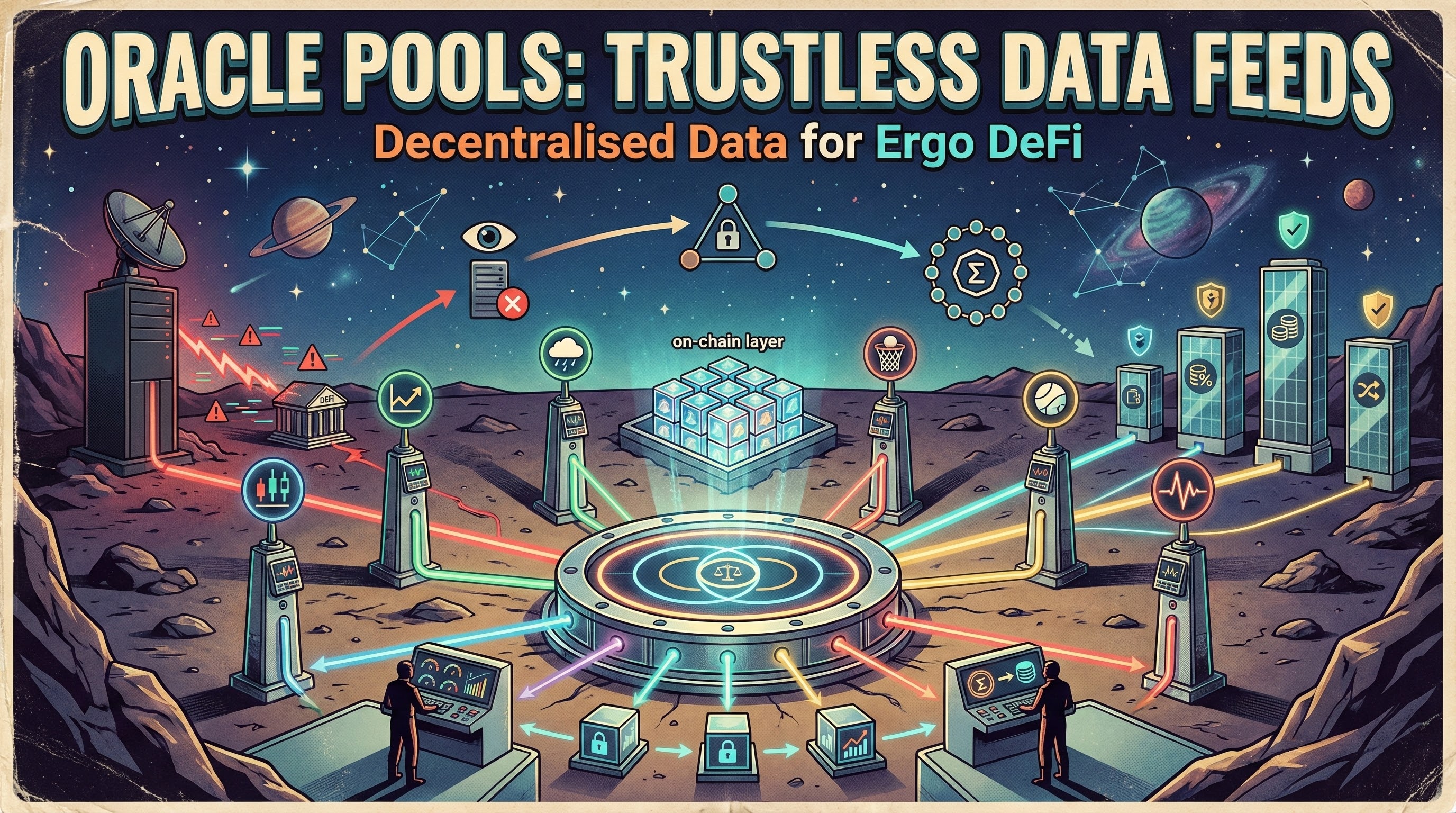
Oracles bridge the gap between blockchains and the outside world. Since smart contracts can't access external data directly, oracles fetch and verify off-chain information (prices, weather, events) and post it on-chain. Ergo's Oracle Pools use decentralized consensus among oracle operators for reliable data.
Key Points
- Brings off-chain data on-chain
- Essential for DeFi (price feeds)
- Oracle Pools = decentralized oracles
- Multiple operators reach consensus
- Resistant to manipulation
- Powers SigmaUSD and other protocols
Use Cases
1
Price feeds for DeFi
2
Sports results for betting
3
Weather data for insurance
4
Random number generation
Related Infographics


Related Articles
Frequently Asked Questions
Questions about Oracle
Common questions about this topic
How to get started with Ergo?
Start by getting a wallet (Nautilus for browser, Terminus for mobile). Back up your seed phrase securely offline. Get some ERG from an exchange (Gate.io, KuCoin) or DEX (Spectrum). Make a test transaction. Then explore: try DeFi on Spectrum, check out NFTs, or dive into the technology if you're a builder.
How-to
Getting Started
How to build DeFi on Ergo?
Building DeFi on Ergo starts with understanding the eUTXO model and ErgoScript. Unlike account-based chains, Ergo's box model provides deterministic execution, no MEV by design, and predictable gas costs. Use Oracle Pools for price feeds, and leverage existing patterns from Spectrum Finance and SigmaUSD.
How-to
DeFi
Is Ergo a good investment?
This is not financial advice. Ergo has strong fundamentals: fair launch (no VC dump risk), innovative technology (eUTXO, Sigma Protocols, NiPoPoWs), active development, and a cypherpunk ethos. It's a smaller market cap project with higher risk/reward than established chains. Research thoroughly, understand the technology, and never invest more than you can afford to lose.
Comparison
Getting Started
How to use Spectrum DEX on Ergo?
Connect your Nautilus wallet to Spectrum Finance, select tokens to swap, review the rate and slippage, then confirm. Spectrum uses AMM liquidity pools for instant trades. You can also provide liquidity to earn fees. All trades are atomic - they complete fully or not at all, with no front-running possible.
How-to
DeFi