Mining
Intermediate
Updated 1/15/2025
What is
Memory-Hard Mining Proof of Work?
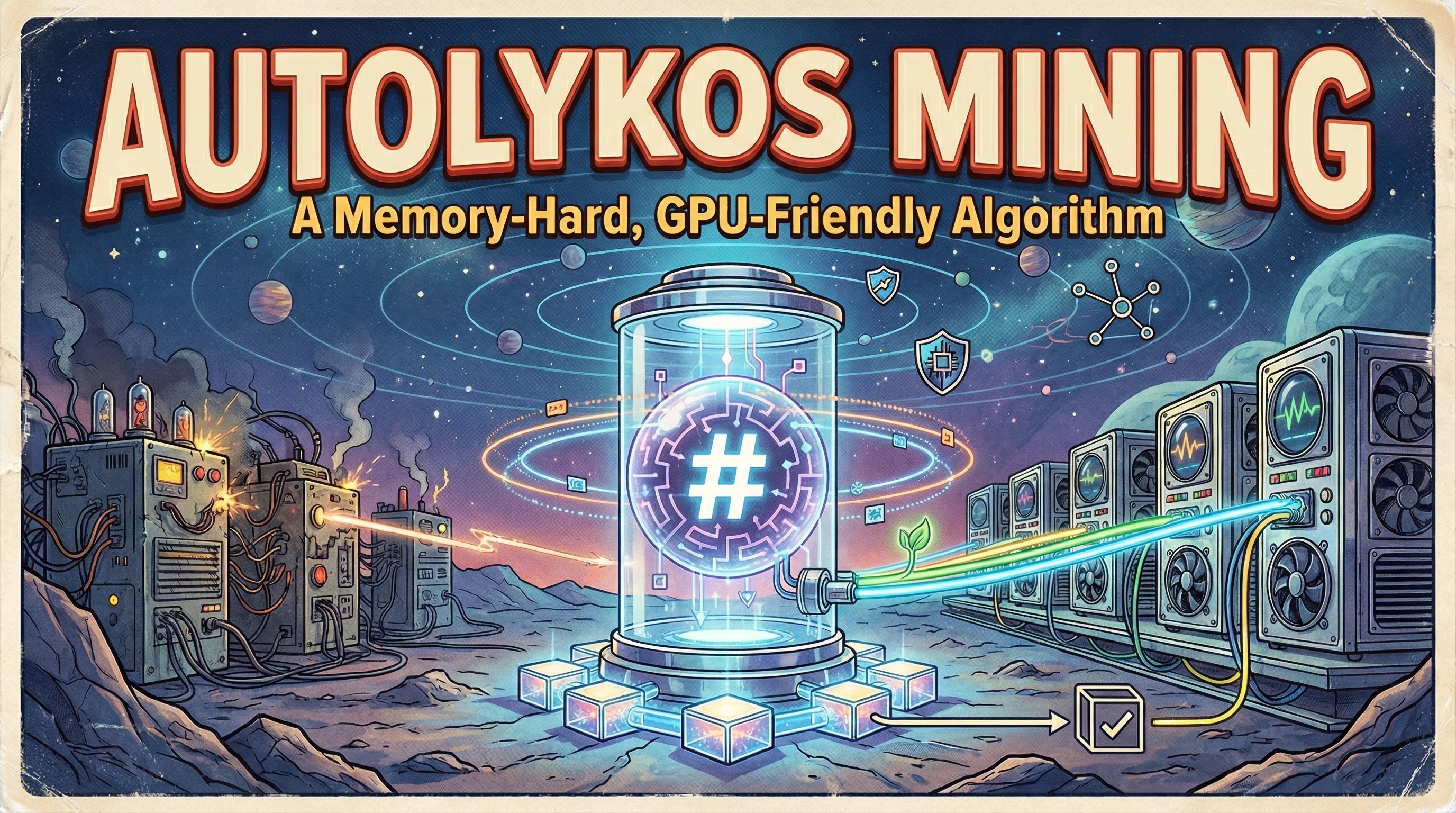
A mining algorithm that requires significant memory (RAM/VRAM) to solve, making ASIC development economically impractical and promoting GPU mining decentralization.
Memory-hard Proof of Work algorithms are designed to require substantial memory bandwidth and capacity to solve mining puzzles, rather than just raw computational power. This makes developing specialized ASIC hardware economically impractical because memory chips are expensive and don't benefit from the same efficiency gains as logic circuits. Ergo's Autolykos 2 is a memory-hard algorithm requiring 4GB+ GPU VRAM, ensuring that consumer graphics cards can mine competitively and preventing the centralization seen in ASIC-dominated networks like Bitcoin.
Key Points
- Requires significant memory (VRAM) to mine
- Makes ASIC development economically impractical
- Ergo's Autolykos 2 requires 4GB+ GPU VRAM
- Promotes decentralization through GPU mining
- Memory bandwidth is the bottleneck, not compute
- Prevents mining centralization by large ASIC farms
Use Cases
1
Understanding why Ergo is ASIC-resistant
2
Evaluating GPU requirements for mining
3
Comparing mining decentralization across blockchains
4
Assessing long-term mining accessibility
Technical Details
Memory-hard algorithms force miners to store and access large datasets in memory during puzzle solving. Autolykos 2 uses a table of ~2GB that must be stored in GPU VRAM and accessed randomly during mining. Since memory bandwidth doesn't scale as efficiently as compute in ASICs, the cost advantage of specialized hardware is eliminated. The algorithm also uses Blake2b hashing and requires solving equations that depend on the memory table contents.
Related Infographics


Related Articles

Frequently Asked Questions
Questions about Memory-Hard Mining Proof of Work
Common questions about this topic
How to get started with Ergo?
Start by getting a wallet (Nautilus for browser, Terminus for mobile). Back up your seed phrase securely offline. Get some ERG from an exchange (Gate.io, KuCoin) or DEX (Spectrum). Make a test transaction. Then explore: try DeFi on Spectrum, check out NFTs, or dive into the technology if you're a builder.
How-to
Getting Started
What is the best GPU for Ergo mining?
For Ergo mining, GPUs with high memory bandwidth perform best. Popular choices include NVIDIA RTX 3060 Ti, 3070, 3080, and AMD RX 6800 XT. Minimum 4GB VRAM required. The best GPU depends on your budget, electricity cost, and availability. Efficiency (hashrate per watt) matters more than raw hashrate.
Explainer
Mining
Why does Ergo's fair launch matter?
Ergo had no pre-mine, no ICO, no VC allocation. 100% of ERG comes from mining. This means no insiders dumping on you, no VCs controlling governance, no foundation with majority stake. Fair launch creates genuine decentralization - the network belongs to miners and users, not early investors seeking exit liquidity.
Philosophy
Philosophy
What is Autolykos and how does it work?
Autolykos is Ergo's memory-hard Proof-of-Work algorithm designed for GPU mining. It requires significant RAM (currently ~2.5GB), making ASIC development uneconomical. Autolykos v2 (current version) allows pool mining while maintaining ASIC resistance. The algorithm promotes decentralization by keeping mining accessible to consumer hardware.
Explainer
Mining